01
Production Tracking
Capture and present selected production status, counts and manufacturing information.


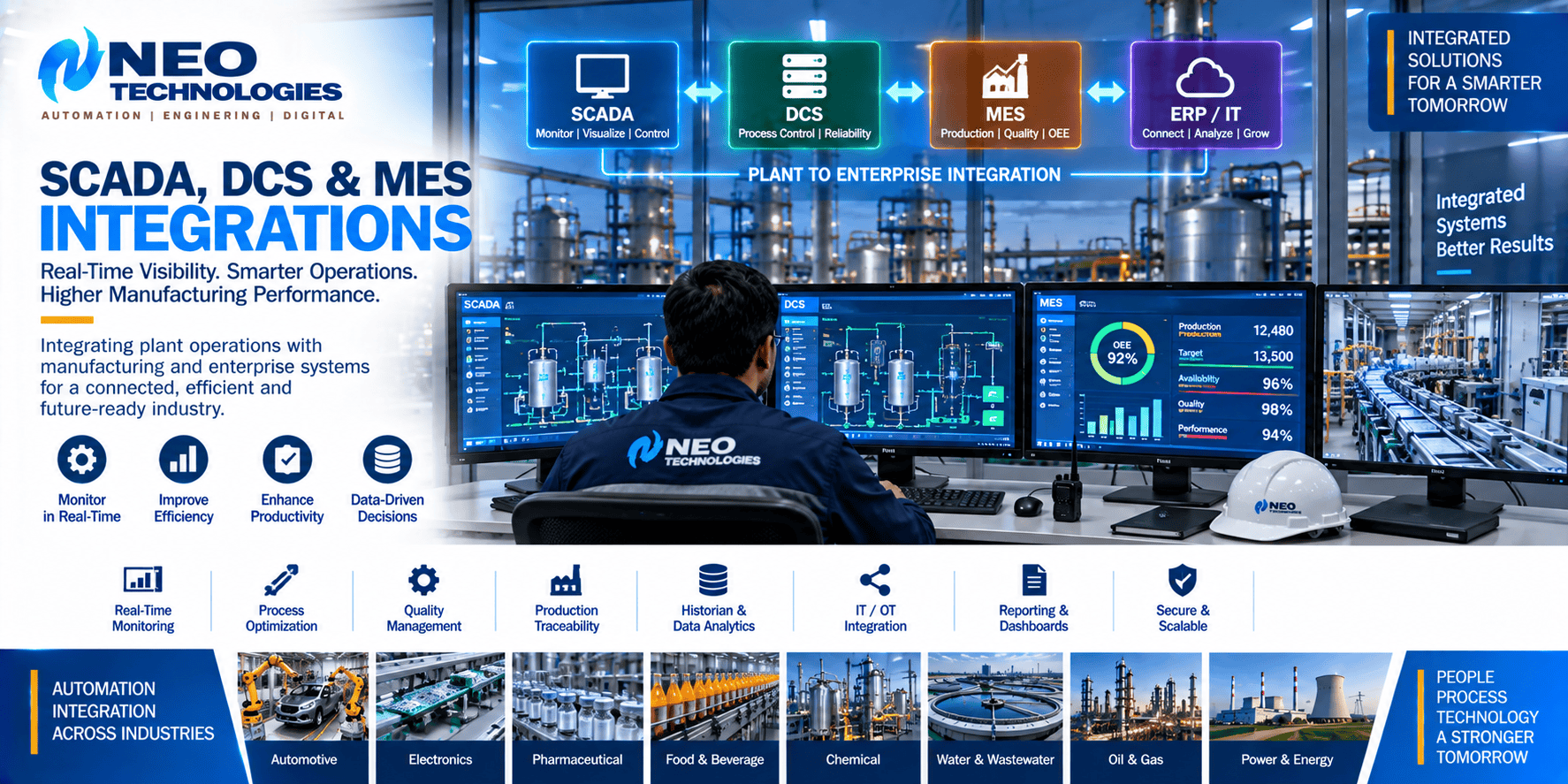
Neo Technologies provides engineering and integration services for SCADA, DCS and MES environments that connect industrial control, supervisory monitoring, production information and selected enterprise applications.
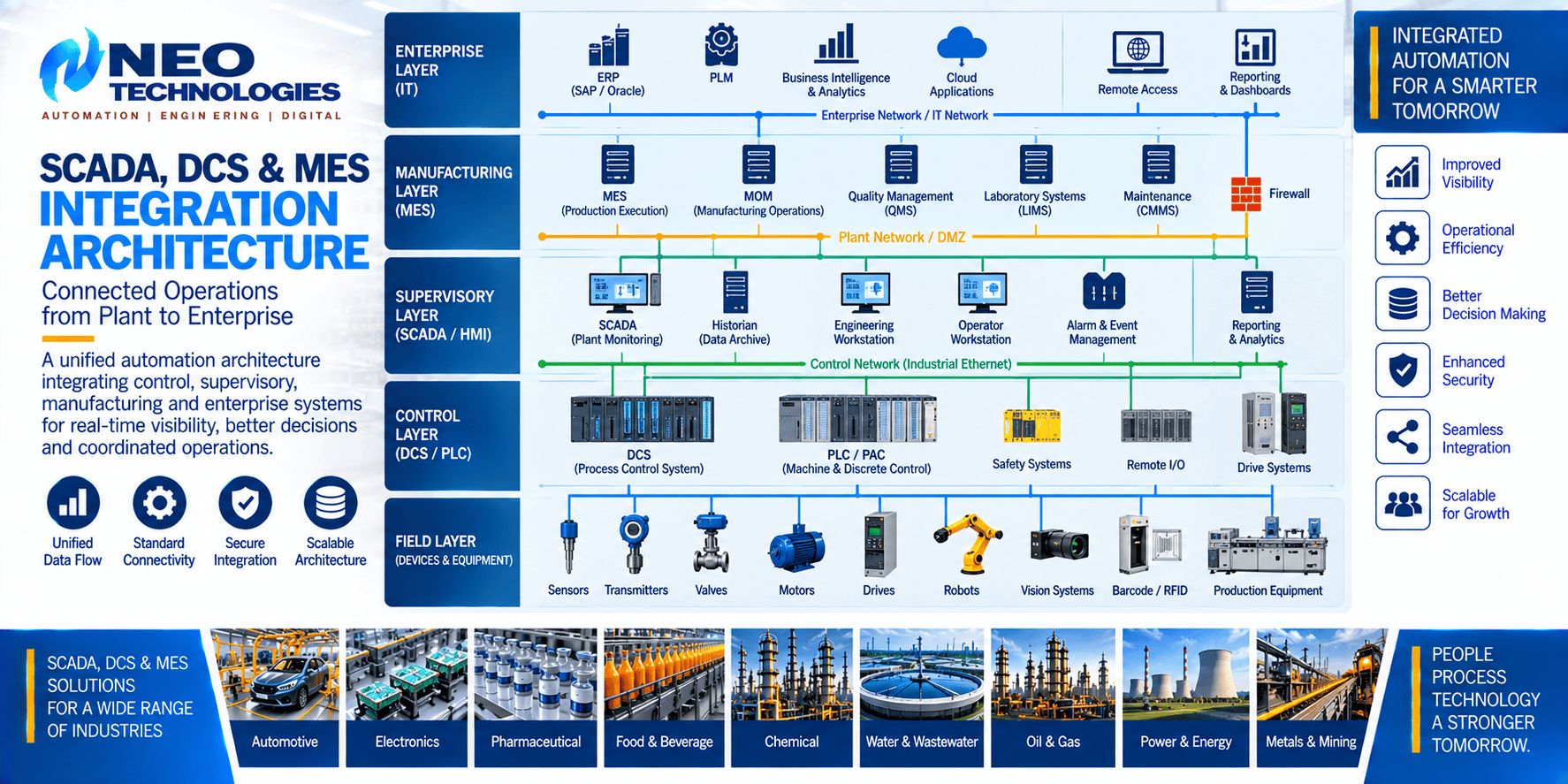
Industrial operations generate information at multiple levels. Instruments and machines create field data, controllers execute process and machine logic, SCADA provides supervisory visibility, DCS manages distributed process control, and MES applications use selected manufacturing information for production operations.
Integration can connect appropriate information between field equipment, controllers, supervisory systems, manufacturing applications and higher-level information systems.
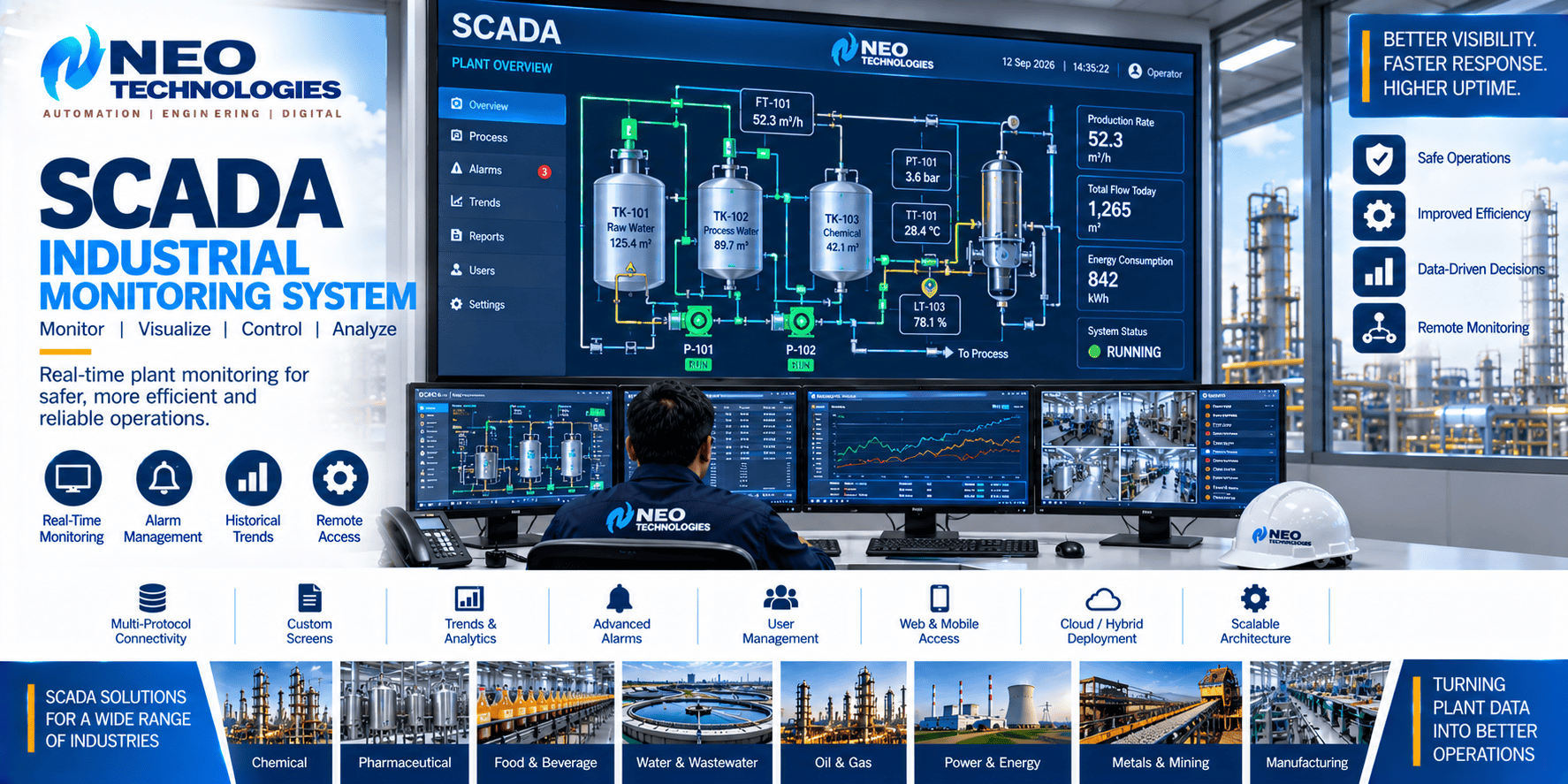
SCADA provides operators and engineers with a supervisory view of industrial processes, machines, utilities and distributed plant equipment.
SCADA project scope can include tag engineering, process graphics, alarm configuration, trend displays, reports, controller communication, historian connectivity and operator interfaces.
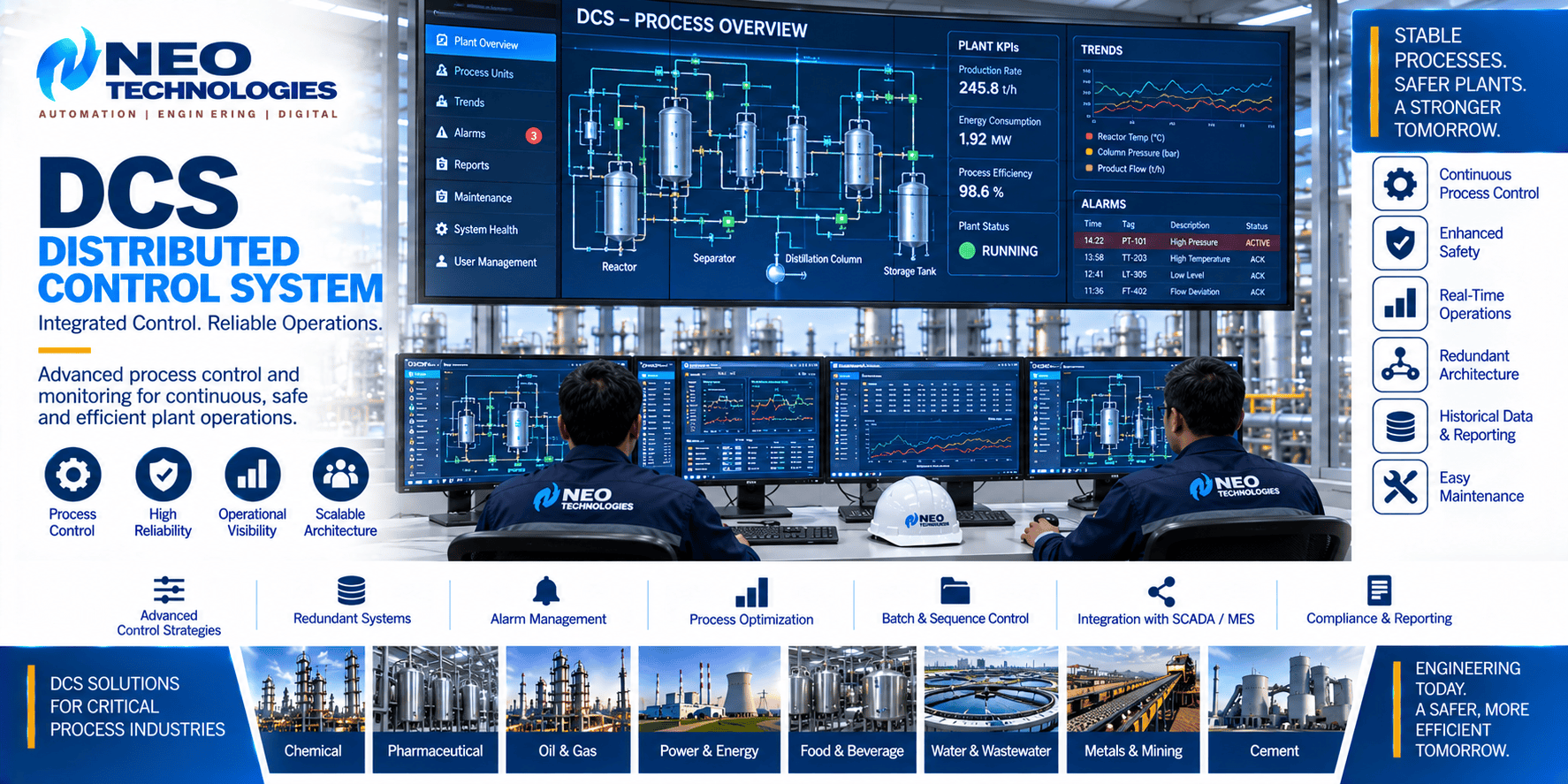
Distributed Control Systems provide structured control architecture for continuous and process-oriented industrial applications.
DCS engineering can include process-control configuration, controller and I/O engineering, operator graphics, instrumentation interfaces, alarms, trends, sequences, historian interfaces and integration with other plant systems.
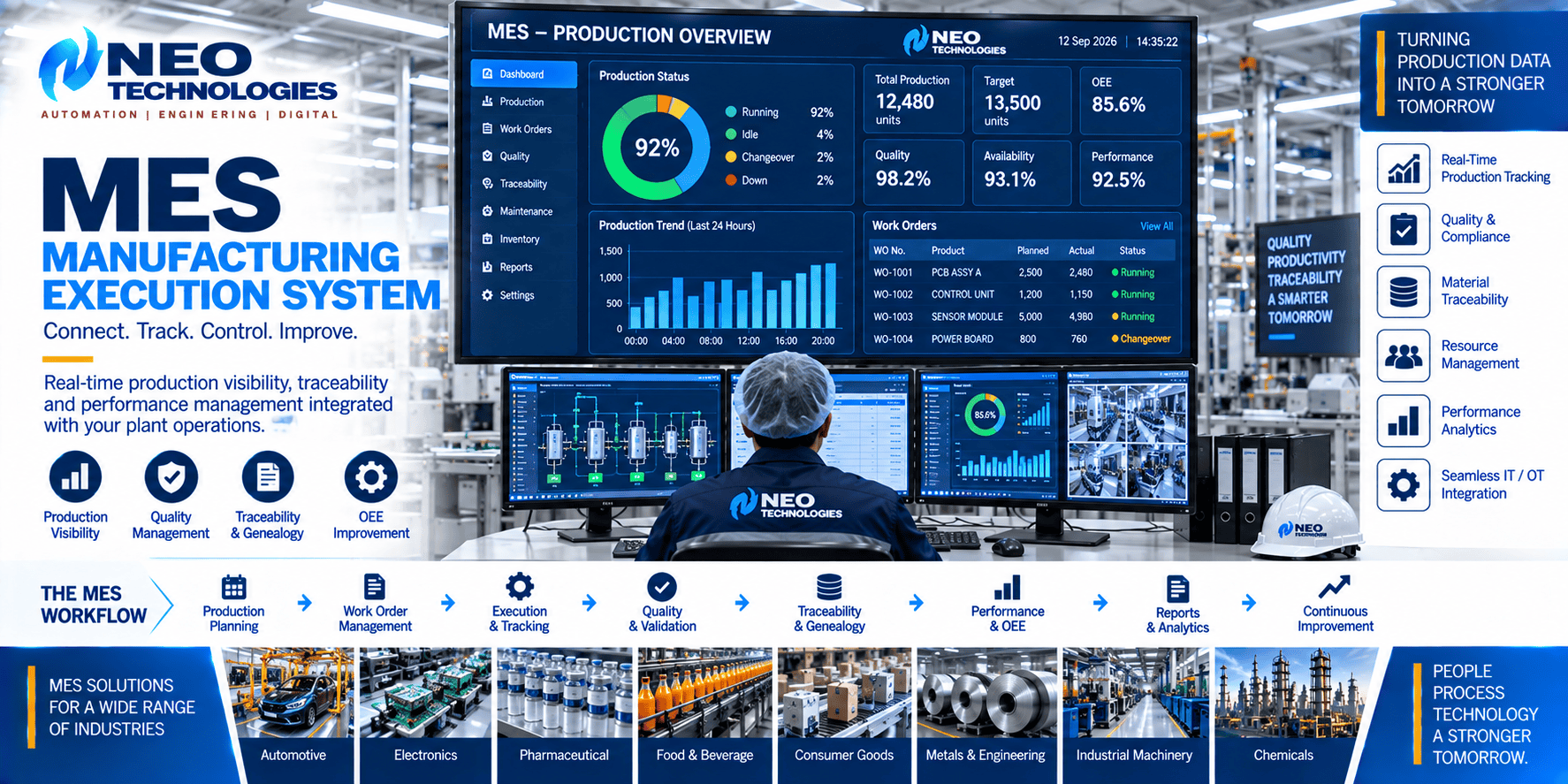
MES can connect selected production and automation information with manufacturing operations such as work orders, production tracking, quality information, traceability and performance reporting.
Capture and present selected production status, counts and manufacturing information.
Exchange appropriate production-order information with manufacturing operations.
Associate relevant quality and process information with manufacturing activity.
Capture product, batch, lot, serial and process information where required.
Present selected production and equipment performance information.
Provide application-specific production, quality and operational reports.
Exchange appropriate information with PLC, SCADA and historian systems.
Connect selected manufacturing information with suitable higher-level applications.
A structured architecture separates field, control, supervisory, manufacturing and enterprise functions while allowing required information to move between appropriate system layers.
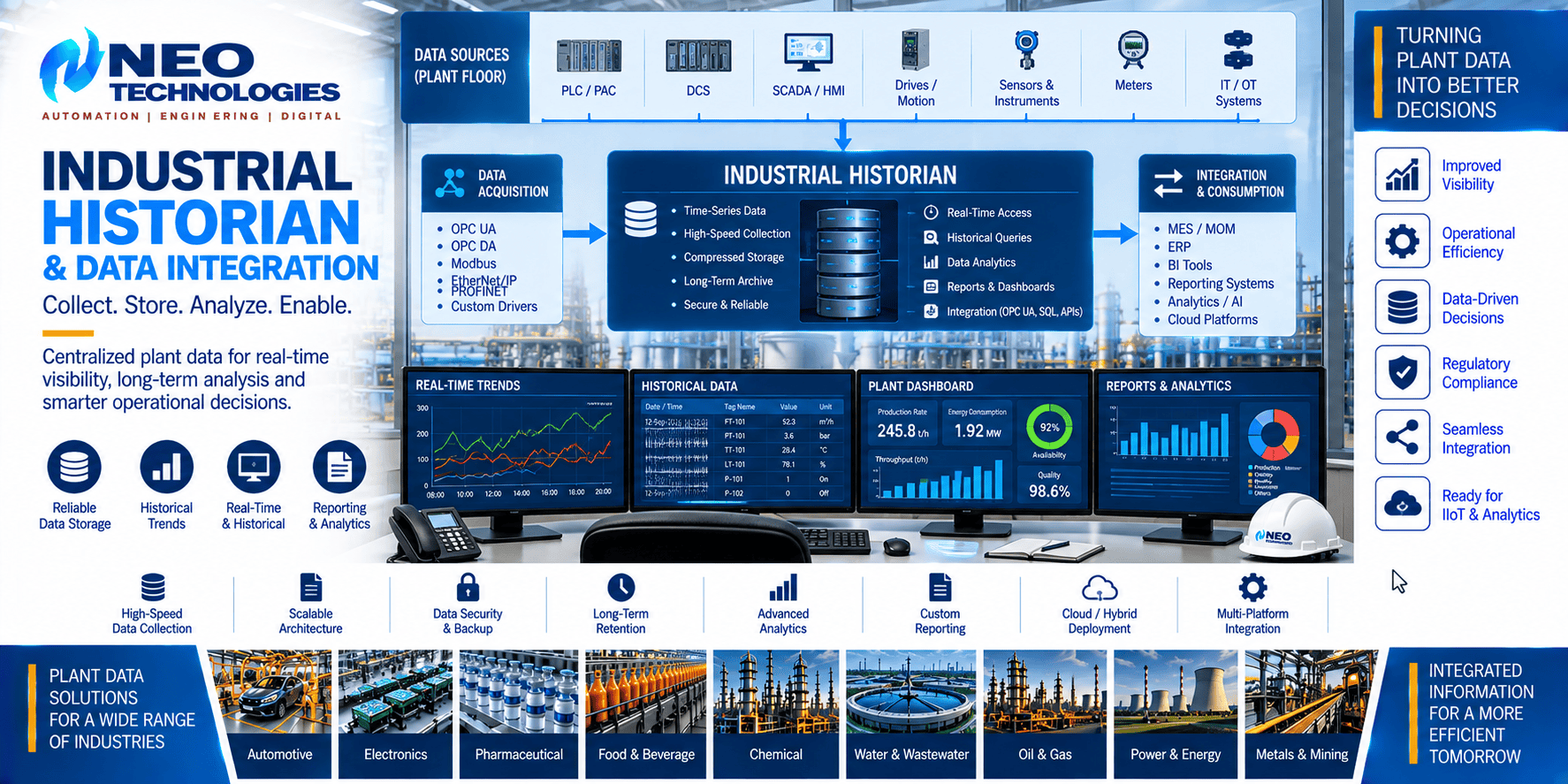
Industrial historian systems provide a structured layer for storing time-series information acquired from industrial automation and process-control systems.
Historian integration can be engineered according to the data sources, retention requirements, reporting needs and interfaces available within the selected platforms.
Supervisory and information systems can organize plant data into operator displays, alarm information, historical trends and project-specific reports.
Configure process and equipment alarms with priorities, messages and operator information.
Display selected process variables and equipment values over configurable time periods.
Record applicable system and operational events for review and troubleshooting.
Develop application-specific reports from available process and production information.
SCADA, DCS, historians and MES applications depend on appropriate communication interfaces between plant-floor and information systems.
The integration method should be selected according to the installed platforms, available interfaces, data requirements and project architecture.
Protocol availability and implementation depend on the specific controllers, software platforms and equipment included in the project.
MES applications can organize production, quality, traceability and equipment information into a structured manufacturing view.
The exact traceability model and OEE calculation should be defined from the production process, equipment states, quality requirements and available data.
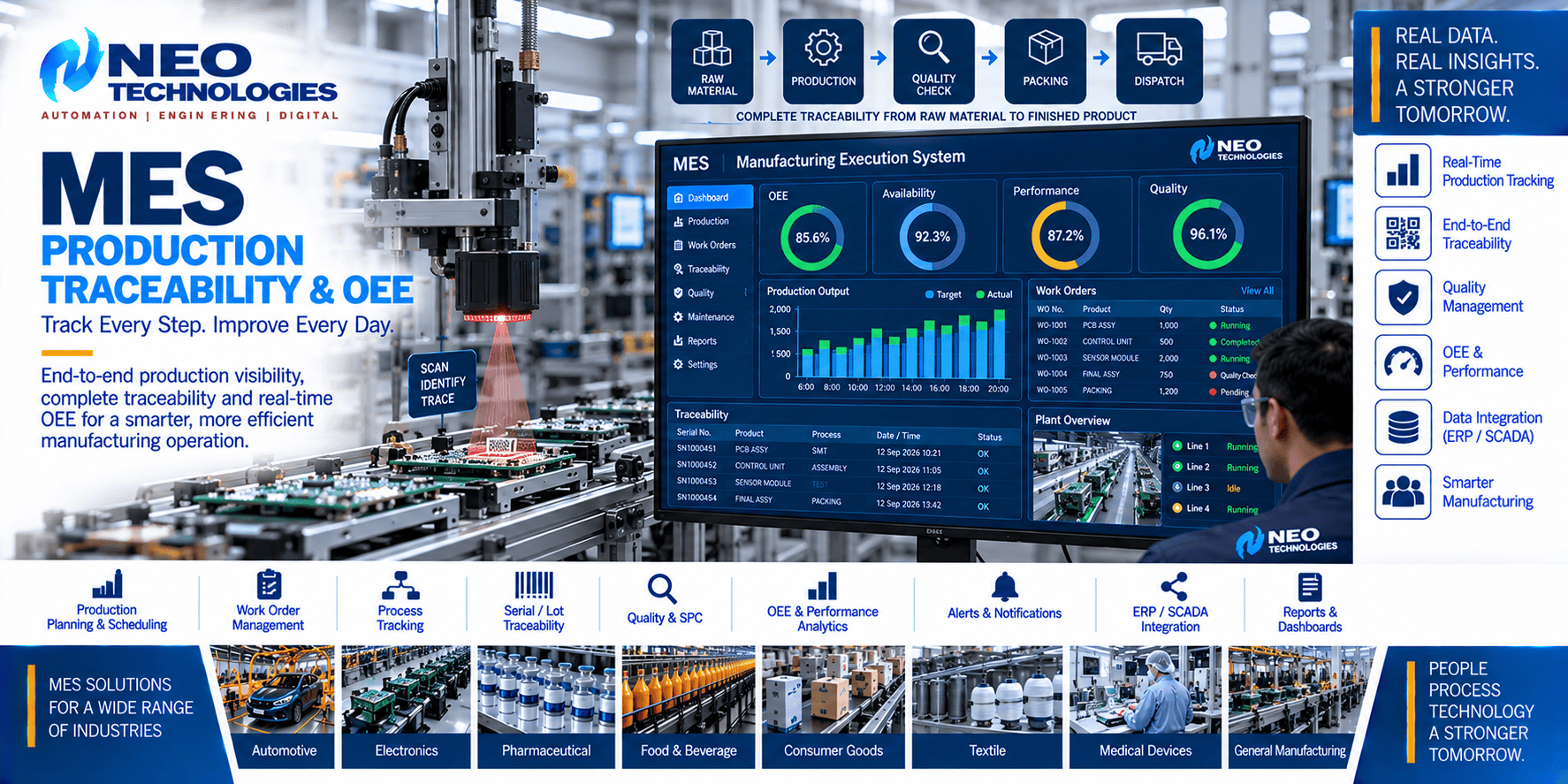
The appropriate combination of SCADA, DCS, historian and MES technologies depends on the type of process, production environment and required information flow.
Control and manufacturing information requirements vary by process, equipment and production environment.
Process monitoring, control and operational information.
Continuous and batch process-control applications.
Process, production and manufacturing information systems.
Processing, production monitoring and manufacturing data.
Production lines, traceability and manufacturing information.
Production tracking, equipment integration and traceability.
Distributed monitoring, pumping, treatment and SCADA.
Plant monitoring, utilities and operational information.
Process, equipment and material-handling monitoring.
Process control, drives, equipment and plant monitoring.
Machine, utility and production-information integration.
SCADA, production tracking, historian and MES applications.
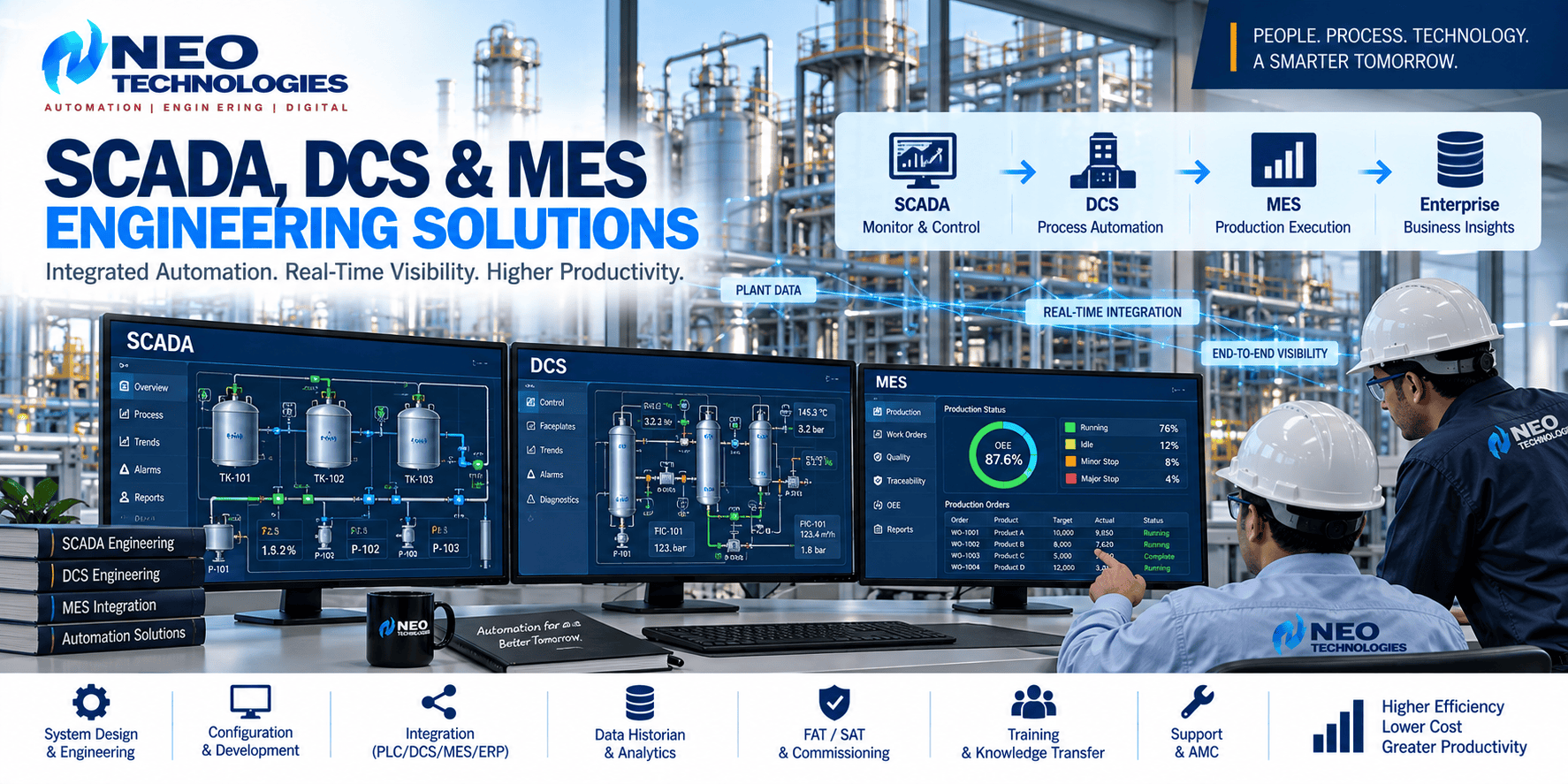
Projects can combine automation engineering, supervisory software, industrial data integration and manufacturing information systems within one coordinated architecture.
Existing supervisory and process-control systems can be assessed for migration, expansion or integration with newer automation and information platforms.
Modernization strategy should consider existing controllers, I/O, field equipment, operator stations, software, communication networks, historical data and available documentation.
Documentation is prepared according to the agreed project scope and available project information.
Control, supervisory, information and communication architecture.
Applicable process, equipment and information tags.
Configured alarm information according to project requirements.
SCADA and operator-interface graphics included in scope.
Communication topology and system interface documentation.
Required data exchange between automation and information systems.
Applicable functional, FAT and SAT documentation.
Software and configuration backups according to agreed handover scope.
SCADA, DCS and MES perform different functions. The integration objective is to connect the information required by each layer without treating them as the same system.
Process and machine control remain within the appropriate control layer.
Supervisory systems provide plant and equipment information to operators.
Selected process and production information can be stored for historical use.
Manufacturing systems use appropriate production and operational information.
Connect PLC, DCS, SCADA, drives, robotics, industrial networks and manufacturing information systems.
System IntegrationProcess control, instrumentation, PLC, DCS, SCADA, control panels and industrial communication.
Process AutomationPLC, HMI, drives, servo, robotics, machine vision and connected machine automation.
OEM Machine SolutionsIndustrial Ethernet, communication architecture and automation-system connectivity.
Industrial NetworkingPLC, HMI, drive and industrial control-panel engineering for automation applications.
PLC Control PanelsMobile controllers, CAN/J1939, HMI, hydraulics, sensors and machine-control integration.
Off-Highway AutomationShare your existing system architecture, controller details, I/O information, SCADA or DCS platform, communication requirements, production workflow and required manufacturing-data interfaces with Neo Technologies.
Discuss Your ProjectSCADA is a supervisory control and data acquisition system used to monitor and, where appropriate, control industrial processes and equipment through operator interfaces, alarms, trends and data acquisition.
A Distributed Control System is a control architecture commonly used in process applications where control functions are distributed across controllers and I/O systems while being supervised through integrated operator and engineering environments.
A Manufacturing Execution System manages and presents selected manufacturing operations information such as production status, work orders, traceability, quality and performance data.
DCS primarily performs process control, SCADA provides supervisory monitoring and control, while MES operates at the manufacturing-operations layer using selected production and process information. Their exact functions depend on the platforms and application architecture.
Yes, when the selected systems provide compatible communication interfaces. The integration method depends on the installed platforms, required data and available protocols.
Yes. Selected PLC, SCADA and historian information can be exchanged with MES applications when suitable data interfaces are available.
An industrial historian stores time-series information from automation and process systems so selected values can be reviewed historically and used for trends, reports and other applications.
MES applications can support serial, lot, batch and process-data traceability when the required identification and production information is available from the manufacturing process.
OEE can be calculated when the required availability, performance and quality information is defined and reliably available from the relevant production systems.
Existing systems can be assessed for migration, expansion or integration. The approach depends on installed hardware, software, field I/O, communication interfaces and project requirements.
Depending on the agreed project scope, engineering services can include functional testing, FAT, site integration, SAT, startup and commissioning support.
Useful inputs include process descriptions, controller details, I/O lists, existing architecture, tag databases, network information, communication protocols, production workflow and required system interfaces.